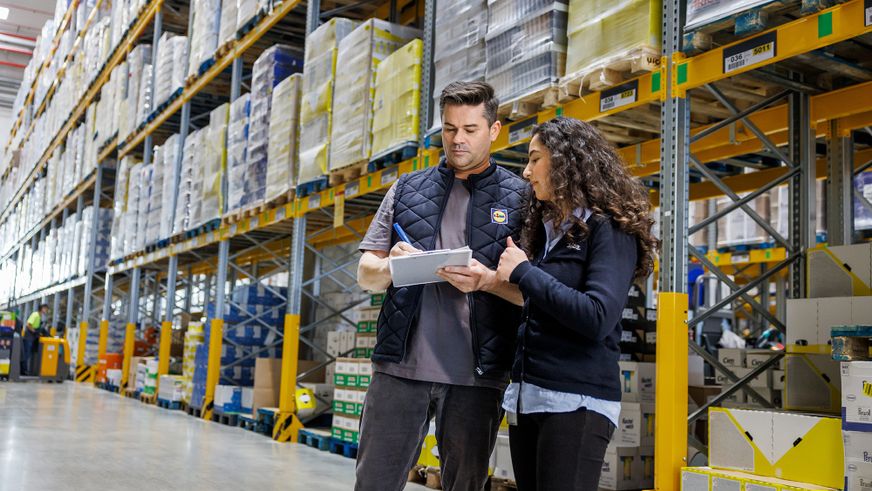
Two Lidl logistics employees focused on checking inventory in a modern, brightly lit pallet warehouse.
  • NL
  • AT
  • CH
  • DE
  • SE
Lidl StoryProtecting climate

On course towards future-ready logistics

A significant share of our greenhouse gas emissions comes from transport. That is why we are digitalising our logistics and promoting alternative drive technologies. This is how we reduce our CO2 footprint and make our transport routes lower-emission step by step.

Reducing emissions through digital route planning

When a Lidl truck leaves the warehouse early in the morning, many decisions have already been made: which route saves the most energy? Which stores can be combined most efficiently? How can empty runs be avoided? Questions like these are part of our digital, data-driven logistics system, which works every day to reduce emissions.

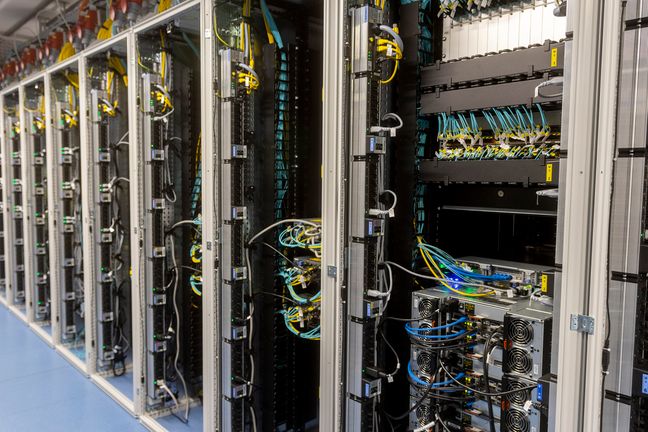
High-performance IT infrastructure with server racks and blue cabling, controlling Lidl's efficient climate-controlled logistics.
Thanks to smart route planning, we avoid empty runs and optimize the utilization of our modern vehicle fleet.

With the help of software-based solutions, we optimise routes, manage return transport more flexibly and make our network more efficient. Because the better the utilisation, the lower the emissions. The system also learns continuously: it dynamically adapts to daily order volumes and regional differences. This is how we combine resource-efficient processes with operational efficiency.

"Efficient logistics means reducing emissions on every kilometre. We achieve this, for example, through intelligent route planning and the targeted promotion of alternative drive technologies."

Bernd Hegwein
Head of Systems & Processes Transport at Lidl Stiftung & Co. KG

Moving forward with battery power

At the same time, we use alternative drive technologies. More than 90 battery-electric trucks with trailers are already in operation across all Lidl countries (2025 financial year). In particular, the Netherlands, Austria, Switzerland, Germany, and Sweden are continuously expanding their e-fleets. At the same time, Lidl is further developing its network of charging stations to ensure that the trucks can be charged reliably. To drive the electrification of the vehicle fleets forward in a structured way, Lidl has developed the “Playbook Electric Transport”: a standard concept for site selection, charging parks, infrastructure, and energy management using PV systems and battery storage systems. Expansion in France, Poland, and Denmark is planned for 2026.
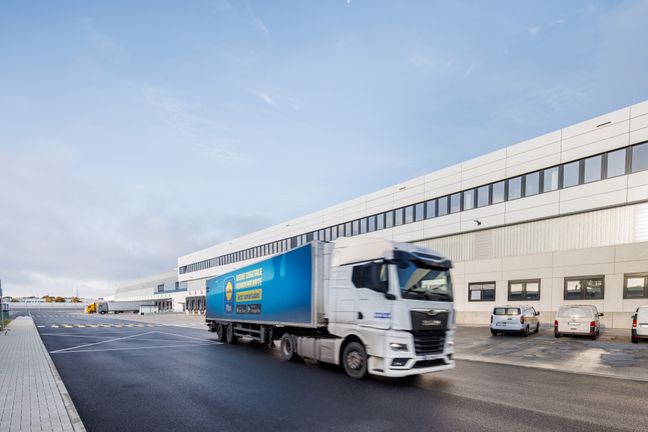
A Lidl e-truck driving past a modern logistics center in broad daylight.
Through the targeted use of battery-electric trucks, we make store delivery quiet and climate-conscious.
A smiling female employee steering a forklift through the high-bay aisles of a Lidl logistics warehouse.
Our intelligent digital networking ensures efficient logistics processes and a smaller carbon footprint.

In addition, we are breaking new ground in procurement logistics: in several countries, we are working with partners to shift transport from road to rail. We have also entered into partnerships for transporting our goods using alternative drive technologies.

All these measures serve one goal: to reduce emissions in logistics and thereby contribute to a lower CO₂ footprint in transport.

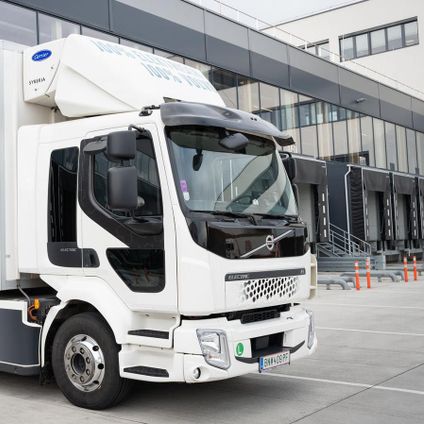
A fully electric Lidl truck at a loading bay, symbolizing the journey toward an emission-free logistics fleet.
More than 90battery-electric trucks are in operation across all Lidl countries (financial year 2025).

Questions? We’re happy to help!